Vista Assessments
A website, an outreach engine to school districts, and the portal where the owner says yes to every email.
Client: Vista Assessments. Bilingual (Spanish/English) school psychology, founded by John Calzada. Based in Rhode Island, serving school districts across New England. Work shown from July to September 2026. Page published September 30, 2026.
Vista Assessments has a new website and an outreach engine that reaches school districts on its behalf, and every email waits in the owner's own portal until he approves it. LaunchPad built both and runs the engine with him.
Where it started
Vista Assessments provides bilingual, Spanish and English, psychological evaluations for PK-12 learners, working with school districts, administrators and evaluation teams across New England. Its founder, John Calzada, is a school psychologist running the practice himself. The site he came to us with said the practice had impacted more than 500 students.
He had two audiences and one problem. The buyers are school districts and their special education directors. The future contractors are other school psychologists who would let the practice take on more. The problem was reach: the districts who need a bilingual evaluator do not know he exists, and he did not have hours to spend finding and writing to them one by one.
Discovery was July 15, 2026, the proposal and kickoff followed on July 30, and the work ran through the summer. The rule for the website was set on day one: elevate what exists, and do not add new information. His copy and his claims stayed his; we improved the presentation, not the substance.
The public work, in Vista's colors.

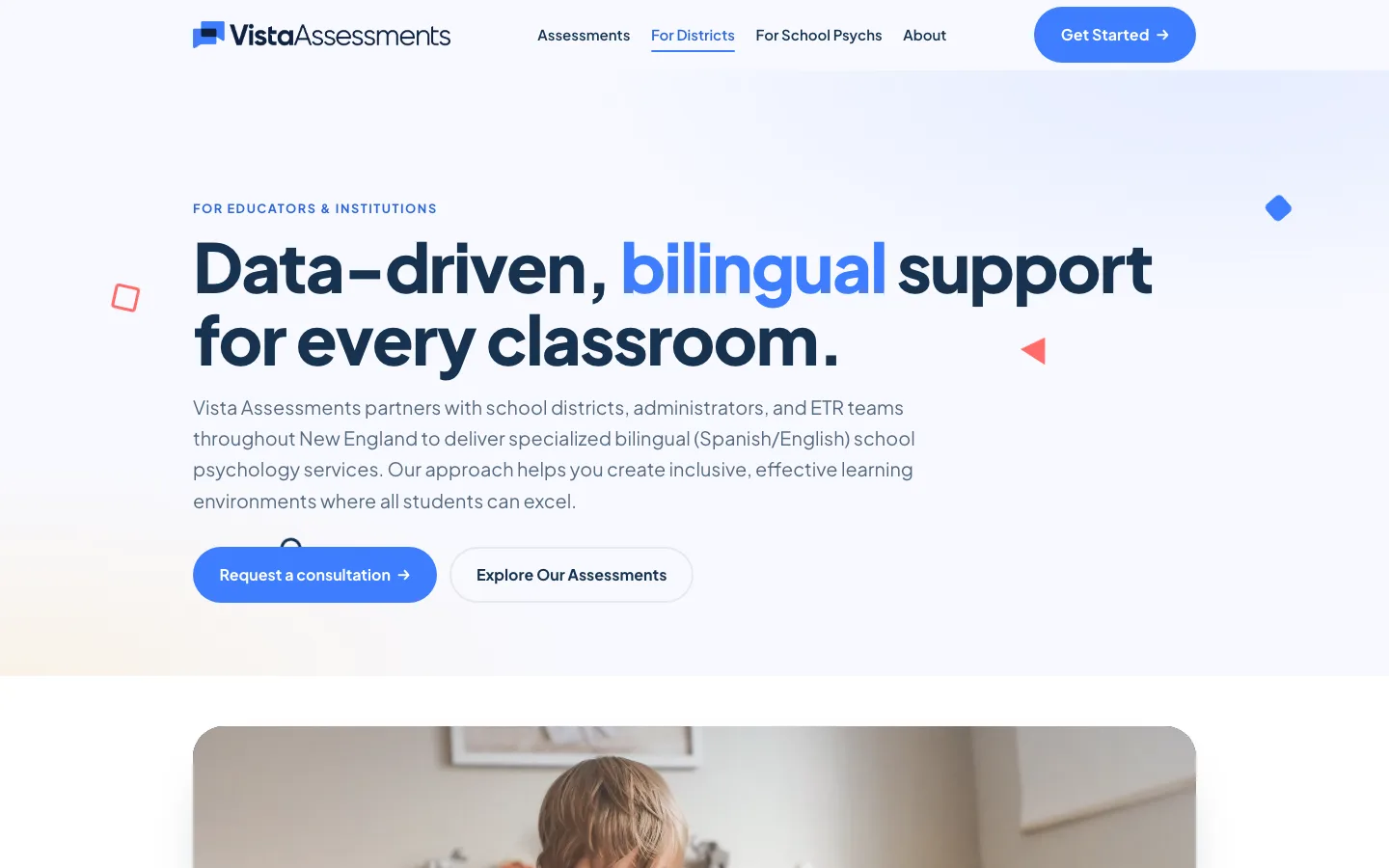
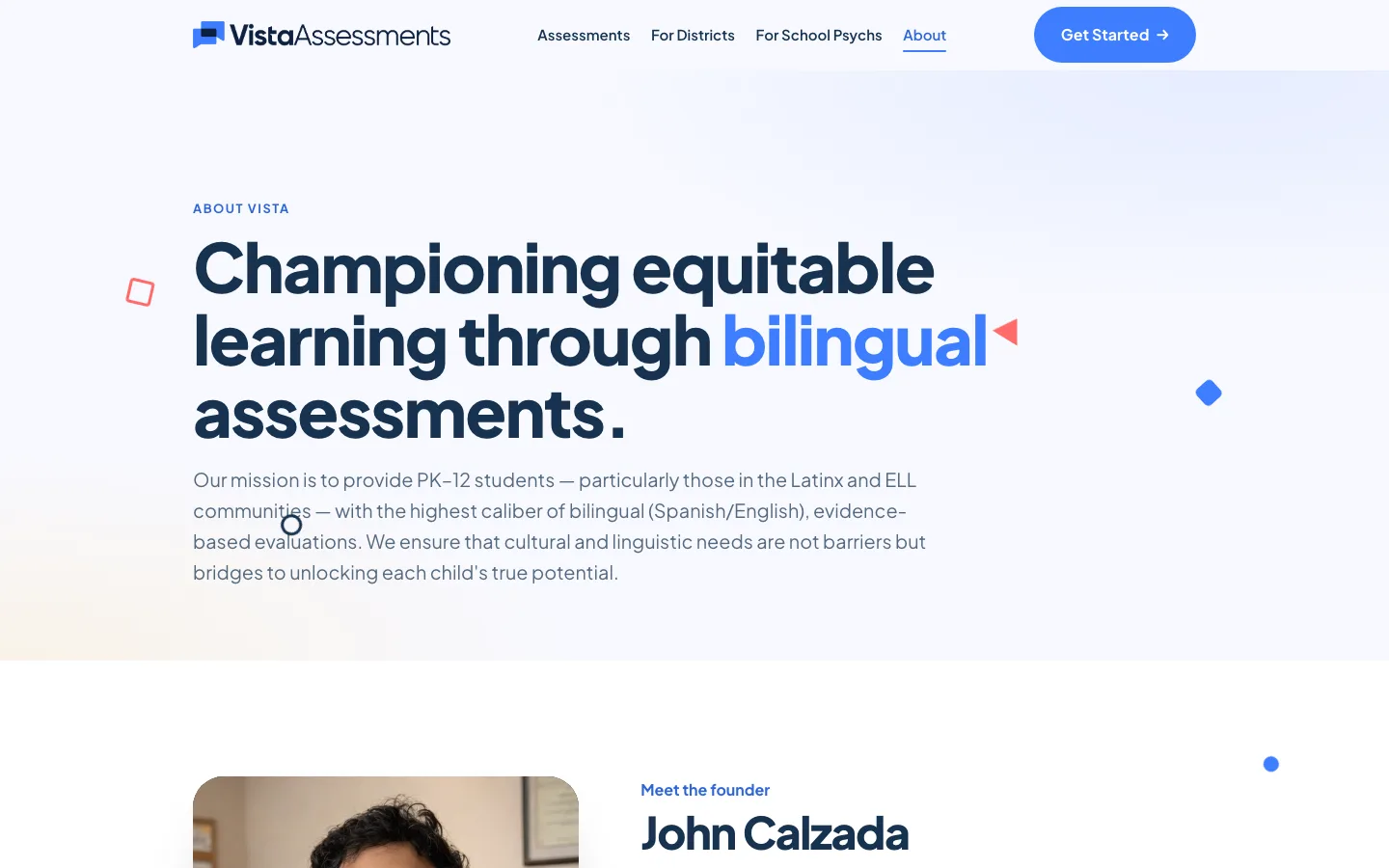

An engine that finds the districts, and a portal where the owner decides.
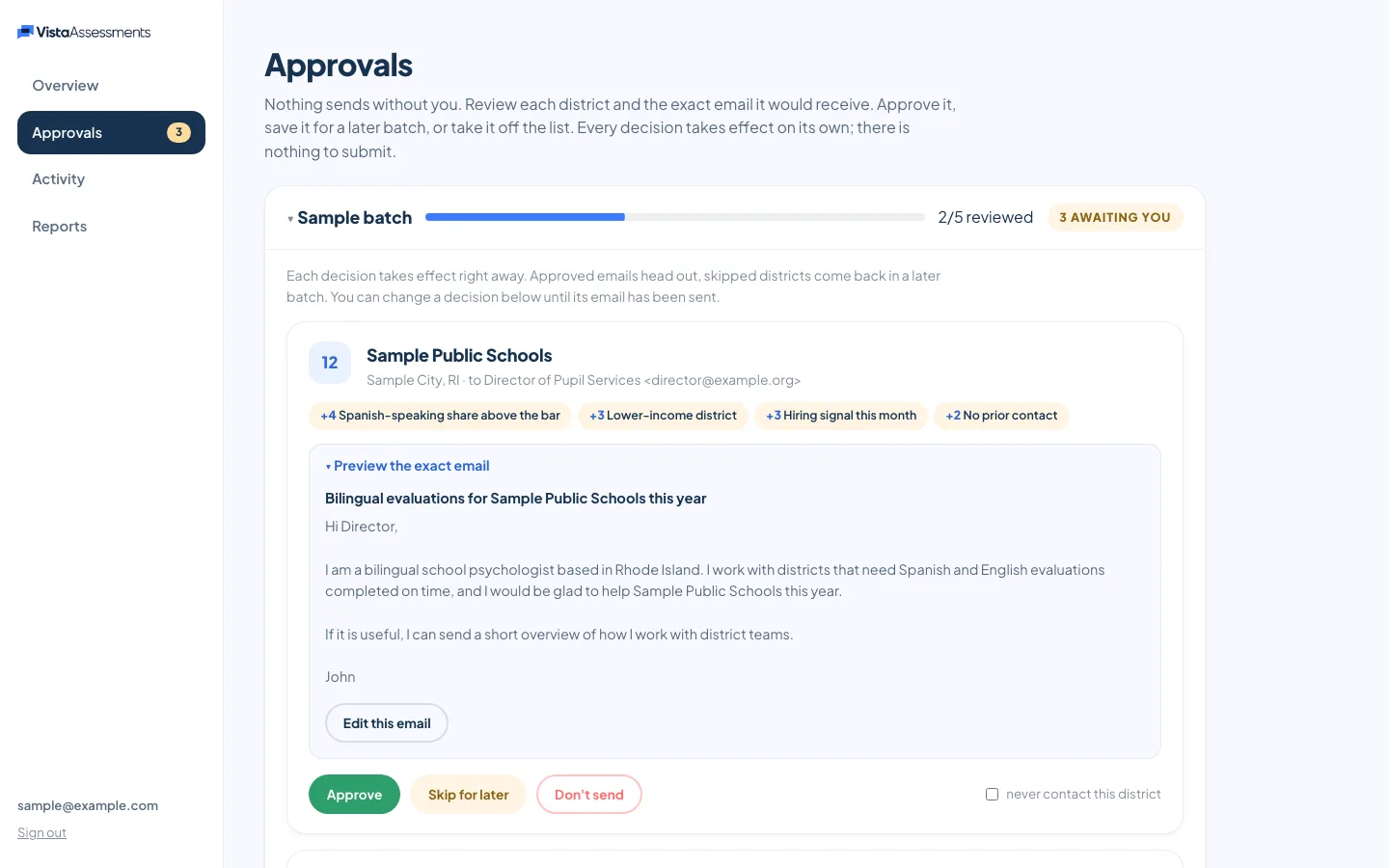
The approval portal
The portal is the owner's view of the engine: an overview of the pipeline, the approval queue, an activity feed and monthly reports. It was not in the proposal. He had been promised that we would track outreach and report back; he got a live view of it instead, because the approval gate had to be fast for him or the engine would stall.
Each district card shows a fit score out of 15, the reasons it was picked, and the exact email it would receive, which he can edit in place. Three buttons: Approve, Skip for later, Don't send. Every decision takes effect the moment it is clicked, with nothing to submit. Decided cards move to a reviewed list where he can change his mind until the email has actually been sent. Within ten minutes of any decision, the LaunchPad team gets a digest email.
Since September 16 the sending lives in the portal too. Approved emails wait under Approved and queued, each with Open in Gmail, which prefills the message in the practice's own mailbox, and Mark as sent, which logs the touch, schedules the follow-up for fourteen days later, and moves the district to contacted. There is a fifteen-minute undo.
How a district gets picked
The engine loads public district data for Rhode Island first and then Massachusetts, and scores each district on the criteria the owner set: the share of Spanish-speaking and English-learner students, the share of lower-income families, whether it is a charter school, and whether it is hiring a school psychologist. A verified, named contact adds to the score. Batches are assembled from the top of that list.
Contacts come only from published sources, and each one is stored with the source it came from. The rule is never to invent, guess or pattern-construct an email address; a district with no sourced email stays in the queue without one. Opt-outs, bounces and the owner's exclusions land on a do-not-contact list that every batch is checked against before it is assembled.
The email, in the owner's words
The first-touch email is the owner's own copy, supplied September 8, 2026. It replaced an earlier version that generated a personal line per district; his plain paragraph read better than anything assembled from data fields. The follow-up is matched to that voice. Each email names the recipient's state rather than ours, at his request.
Every email carries what the law requires: the practice's physical mailing address, a truthful subject line, and a reply-to-remove opt-out. A remove reply goes on the do-not-contact list the same day.
Sending, by a person, from the practice's own mailbox
No script in the engine can send email. Approved emails are drafted into the practice's own Google Workspace mailbox, with the signature embedded, and a person reviews and sends each one. A send is recorded only when it appears in that mailbox's Sent folder; anything that cannot be verified stays unlogged and is named as such. Follow-ups go out two weeks later from the same record.
The mailbox itself was made ready first: the domain's mail records, with SPF, DKIM and DMARC verified, so the practice's email arrives as the practice's email.
Real sign-in, not a password gate
The portal signs people in with a one-time link to an invited email address. There are no passwords. It runs on its own database, separate from anything else LaunchPad operates, and every row is protected by row-level security tied to the signed-in account. An account that is not on the invite list can complete a sign-in and still read nothing. The client's own writes are limited to decisions and inline email edits on a batch that is awaiting approval; the rest happens in database code the portal cannot reach.
Reports and the weekly rhythm
Each month the owner gets a written report with the numbers pulled live from the engine's database, and nothing estimated. The first one, for August 2026, said plainly that the website, portal and email infrastructure were delivered in full and that outreach volume fell short of the target, and it set out the September plan to catch up. The portal's decision digests keep the LaunchPad team current between reports, and the practice's client-side relationship is managed by our chief administrative officer.
What we can show, and what we have not measured yet.
These are the changes we can source. Each line notes where it comes from.
| Measure | Before | After | Where it comes from |
|---|---|---|---|
| Website | A page-builder site on a hosted platform | A six-page static site on the practice's own domain, with a founder section and a page for school psychologists | Live in August 2026. |
| District research | By hand, one district at a time | Scored and sourced district lists for Rhode Island and Massachusetts, assembled into batches | Batch sizes and send counts are the client's to share. |
| Approval | None; no outreach was running | Every district approved, skipped or excluded by the owner in his portal, effective on click | Rolling approvals since August 13, 2026. |
| Sending | None | Prefilled from the portal into the practice's own mailbox, sent by a person, logged from the Sent folder, follow-up scheduled fourteen days out | In the portal since September 16, 2026. |
| Email signature | None on file | Animated, brand-locked signature at 70 KB, hosted on the practice's domain | Assets verified live on the domain August 14, 2026. |
What we have not measured: replies, consultations or contracts that can be credited to the engine. The engine records every send, every reply and every follow-up, and the monthly report carries those figures to the owner. We will add before-and-after numbers to this page once he has approved them for publication.
Questions people ask.
What is an outreach engine?
A system that finds the right organizations to contact, drafts the email each one should get, and keeps the record of what was sent and what came back. Vista's engine targets school districts and charter schools, ranks them on a fit score, drafts each email from the owner's own template, and logs every send and follow-up. The owner approves every district before anything goes out.
Does anything send without the owner's approval?
No. Every district waits in the portal until the owner approves it, saves it for later, or takes it off the list. No script in the pipeline can send email. Approved emails are sent by a person from the practice's own mailbox, and a send is recorded only when it appears in that mailbox's Sent folder.
Where do the contacts come from?
From published sources, each recorded with the contact. The rule is never to invent, guess or pattern-construct an email address. If there is no source, the district stays in the queue without an email until one is found. Opt-outs and the owner's exclusions go on a do-not-contact list that every batch checks first.
Is the portal secure?
Sign-in is by a one-time link to an invited email address, with no passwords. The portal runs on its own database, and every row is protected by row-level security tied to the signed-in account, so an account that is not on the invite list reads nothing.
Did the practice have to change its brand?
No. The website, the portal and the email signature use Vista's own palette, mark and type. The rule on our side is that client surfaces never inherit LaunchPad's styling, and that a client's email signature is hosted on the client's own domain.
What does it cost?
The price depends on the engine a business needs, so we scope it in a strategy session instead of publishing a number here. A build comes first, then a monthly run if you want us to operate it with you.
Bring the list you wish you had time to write to.
This fits a practice or firm whose next clients are a known kind of organization: districts, hospitals, property managers, firms of a certain size. You know who should hear from you. You do not have the hours to find them, write to them and keep the record straight, and you will not hand your name to a system that sends without you.
If that is your situation, book a strategy session. Tell us who should be hearing from you and what you would want to approve before it goes. We will tell you what we would build around it, and how it would run.